
How I Paid Only ₱462 for Colonoscopy and Endoscopy in the Philippines: A Complete Guide to Using HMO and PhilHealth
The ₱462 number does three things at once — it stops the scroll, signals credibility (it's too specific to be fake), and creates a question in the reader's mind that only clicking will answer. Google also rewards first-person health guides because they signal real experience, not generic content.
FINANCIAL LITERACY
David Isaiah Angway RFP
3/26/20267 min read

0:00 – Magkano Talaga ang Colonoscopy at Endoscopy sa Pilipinas?
0:13 – Dalawang Procedure para sa ₱462 Lang — Paano?
0:27 – Bakit Ito ang Pinaka-importanteng "Investment" Mo Ngayon
0:44 – Ang 36 Club: Pag Career Growth Ay Hindi Na Ang Tanging Usapan
1:00 – Bakit Nagparehistro si David: GERD, Lifestyle, at Hustle Culture
2:07 – Sino Ba Talaga ang Kailangang Mag-Colonoscopy? (Check Yourself)
2:38 – Alarming Stats: Colorectal Cancer — 3rd Most Common Cancer sa Pilipinas
3:33 – Prevention vs. Cure: Bakit Mas Mura ang Mag-Check Up Ngayon
3:49 – Ang Prep — Mahirap Ba Talaga? (25 Bathroom Trips Explained)
4:06 – Ang Mga Gamot sa Prep: Dulcolax, Lactulose, Pico-Prep (₱1,123)
4:39 – Pro Tips Para sa Mas Madaling Prep (Taper Diet 3 Days Before)
4:57 – Exact Timeline ng Procedure Day — Simula 3PM Hanggang 8AM
5:09 – Arrival sa Hospital: HMO LOA, PhilHealth Eligibility, at Check-in
5:31 – Sa Loob ng Recovery Room — Ano ang Mangyayari Sa'yo
5:56 – Ang Actual na Procedure: IV, Anesthesia, at 1 Hour 10 Minutes
6:30 – Pagkagising: Walang Sakit, Medyo Lango — Ang Totoo
7:16 – Paano Ko Ginamit ang AI (Gemini) Bago Makita ang Doktor
7:39 – Resulta: Good News + Recovery Plan mula sa Doktor
8:22 – Ang ₱40,000+ Bill — At Kung Bakit ₱462 Lang ang Binayaran Ko
9:38 – 5 Non-Negotiables Bago Mag-Book ng Colonoscopy o Endoscopy
9:47 – Tip #1: Compliance is Key — Huwag Pahirapan si Doc
10:05 – Tip #2: I-Audit ang Iyong HMO Coverage (40K–60K Procedure Ito)
10:17 – Tip #3: I-Update ang PhilHealth — Lalo na Freelancers at Self-Employed
10:35 – Tip #4: Magdala ng Plus One — Huwag Tularan si David
10:49 – Tip #5: Admission o Outpatient? Alamin ang Pagkakaiba
11:15 – Colorectal Cancer Hindi Nagtatanong ng Edad: Chadwick Boseman, Kuya Germs, at Iba Pa
11:57 – Bilang Ama: Bakit Ginawa Ko Ito Para sa Aking Anak
12:47 – Financial Reality Check: ₱462 Today vs. ₱4 Million Mamaya
13:12 – HMO at Critical Illness Plan: Ang Firewall ng Iyong Pamilya
13:47 – Final Message: Mag-Audit ng Kalusugan Mo Ngayon
14:14 – Outro + CTA: Makipag-Usap kay David
How I Paid Only ₱462 for a ₱40,000 Colonoscopy and Endoscopy in the Philippines
A Complete Guide to Using HMO and PhilHealth for Preventive Health Screening
By David Isaiah Angway, Registered Financial Planner • Health & Finance
💡 Quick Summary
David Isaiah Angway, a Registered Financial Planner managing 650+ clients, shares his first-hand experience getting both a colonoscopy and endoscopy at De La Salle Medical Center in Dasmariñas, Cavite — and how he reduced a ₱40,000+ hospital bill to just ₱462 by maximizing his HMO and PhilHealth benefits.
When Your Group Chat Becomes a Doctor’s Lounge
You know you’re officially a Tito or Tita when your group chats stop being about “Saan ang inuman tonight?” and start being about “Ano maintenance meds mo?” or “Sino gastro mo?”
If you were born in the late ’80s or early ’90s — hello, 36 Club! — the conversation around you is shifting. It’s no longer just about career growth; it’s about health preservation. Recently, I had a meeting with friends in the healthcare industry. Instead of talking about investments, we spent the entire time discussing endoscopy and colonoscopy.
For context: I’ve been dealing with constant GERD (Gastroesophageal Reflux Disease) and a weakening Lower Esophageal Sphincter (LES) for over a year. As a financial advisor handling more than 650 clients, I cannot afford to operate at half-capacity. So I started treating my body the same way I treat a financial portfolio — it needs a regular audit before it hits a market crash or, in this case, an ER or ICU stay.
Are You in the High-Risk Zone? (Be Honest)
You might be thinking: “David, I don’t have GERD. Do I really need this?” Ask yourself if your daily life looks like this:
• High-stress meetings back-to-back
• Frequent samgyupsal, fast food, or processed meals
• Sedentary desk work for 8+ hours a day
• Too many cups of coffee or “nightcap” drinks to de-stress
• Skipping the stool test during your annual physical exam because it’s “hassle”
If that list sounds familiar, you are in the high-risk zone. We live in a hustle culture — but our colons were not designed for it. In my financial practice, I regularly meet professionals who are wealthy on paper but completely bankrupt in their gut health because of the lifestyle they chose to build that wealth.
Bottom line: Don’t wait for a symptom to be your alarm clock.
The Reality Check: Colorectal Cancer in the Philippines
According to 2022 GLOBOCAN data, Colorectal Cancer is the third most common cancer in the Philippines — with over 20,000 new cases and more than 10,000 deaths every single year.
The names below are a reminder that this disease does not discriminate:
• Kuya Germs — beloved Filipino broadcaster
• Danny Javier — OPM icon
• Kirstie Alley — Hollywood actress
• Audrey Hepburn — Hollywood icon
• Chadwick Boseman — passed at 43, at the peak of his Black Panther career
• President Ronald Reagan — fought it while in office
Cancer does not care about your fame, your fitness, or your bank account. It only cares if you caught it early enough. Prevention is better than cure — and definitely cheaper than a Z-Benefit package, even if PhilHealth covers ₱150,000 to ₱400,000 for treatment.
The Prep: Yes, It’s 25 Bathroom Trips
Is the prep hard? Yes and no. Yes, because I visited the bathroom about 25 times. No, because the medicine itself is straightforward. The prep kit included:
• 2 tablets of Dulcolax
• 1 bottle of Lactulose
• 2 sachets of Pico-Prep
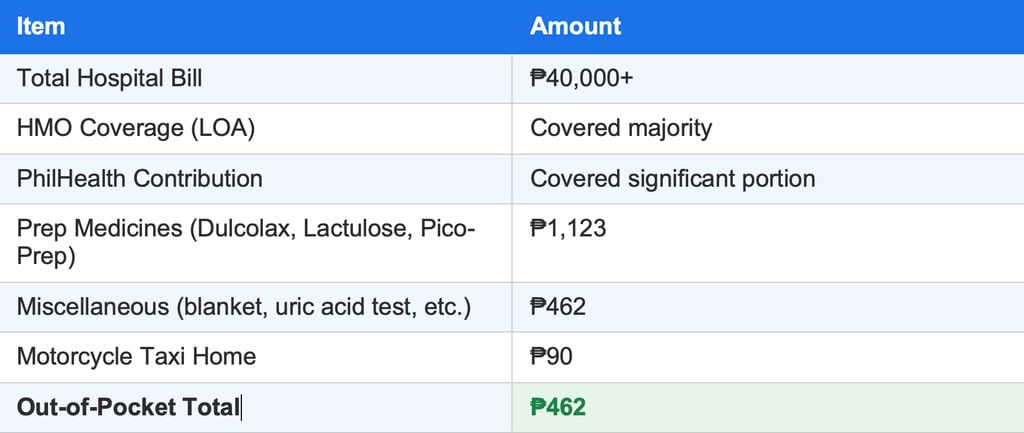
Total cost of prep kit: ₱1,123
Pro Tips for a Smoother Prep
1. Taper your food 3 days before the procedure — do not eat a heavy meal the night before.
2. Drink a lot of water throughout the prep to push everything out.
3. Last solid meal: 3:00 PM the day before the procedure.
4. No drinks after 1:00 AM.
5. Be in bed by 1:30 AM to be well-rested for procedure day.
Procedure Day: “Ganun Lang Yun”
Here is exactly how my procedure day unfolded:
• 6:40 AM: Woke up and prepared for the hospital.
• 8:00 AM: Arrived at De La Salle Medical Center, Dasma. Met the assistant at the Endoscopy unit and submitted my HMO Letter of Authorization (LOA).
• Recovery Room: No phone allowed — just you and your thoughts. IV fluid inserted. Met the team: a nurse with 6 years of experience and two anesthesiologists.
• Operating Table: Anesthesia administered. Endoscopy is done first, followed by colonoscopy.
• 1 hr 10 min later: Woke up in the recovery room. No pain. Just a slight daze.
• Post-Procedure: While waiting for HMO processing (89 people ahead), sent results to Gemini AI for a preview read before the doctor consultation.
• Doctor Consultation: The doctor confirmed everything was clear. Received recovery plan.
• Cashier: Paid ₱462 out of a ₱40,000+ bill.
• 5:00 PM: Home by motorcycle taxi (₱90). Broke fast with tofu, egg, and tilapia.
⚠️ Important Warning: I went solo, and I strongly advise against it. After anesthesia, there is a real risk of falling. Bring a companion to assist with paperwork and ensure your safe exit from the hospital.
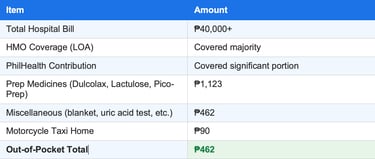
The Bill Breakdown: From ₱40,000 to ₱462
5 Non-Negotiables Before You Book Your Procedure
These are the five things I wish someone had told me before I walked into that endoscopy unit:
1. Huwag Pahirapan si Doc — Compliance is Everything
If your colon is not clean due to poor prep compliance, the doctor may stop the procedure and require you to redo it. That means double the prep, double the cost, double the hunger, and double the inconvenience. Be the patient your doctor thanks.
2. Audit Your HMO Coverage First
Not all HMOs are created equal. Before booking, verify your coverage limit. Colonoscopy and endoscopy procedures can range from ₱40,000 to ₱60,000. Know your ceiling before you walk in.
3. Update Your PhilHealth Contributions
This is non-negotiable. Without active PhilHealth contributions, you will personally shoulder the ₱15,000 to ₱30,000+ that PhilHealth would otherwise cover. If you are a freelancer or self-employed individual, check your contribution status now — not tomorrow.
4. Bring a Plus-One
Going solo is a mistake I will not repeat. Anesthesia affects your coordination and judgment. You need someone to assist with paperwork while you are groggy and to ensure you do not fall on the way out.
5. Admission vs. Outpatient — Know Your Options
You can choose to be admitted overnight or complete the procedure as an outpatient. Outpatient is faster and more convenient; admission is more comfortable if your schedule and HMO allow it. Consult your doctor and HMO to determine the best option for you.
The Financial Realization: ₱462 Today vs. ₱4 Million Tomorrow
In my financial planning practice, I see the same pattern repeatedly: the most expensive medical bill is the one you did not see coming.
Had I ignored my symptoms until they progressed to a Stage 3 or 4 diagnosis, that ₱40,000 bill could have easily become ₱4 million or more. I have personally witnessed families sell their homes, drain their children’s college funds, and wipe out decades of savings within six months of a late-stage cancer diagnosis. That is a financial crash no portfolio can ever recover from.


A Message to Every Parent
We work incredibly hard to build a legacy, a business, a bank account for our children. But the greatest gift we can give them is a healthy, present parent. The last thing I want is for my daughter to spend her early 20s as my caregiver simply because I was too busy or too proud to get a check-up.
Let us be the strong foundation our families deserve — not a medical emergency they have to manage.
Audit Your Health Today
As a professional, your greatest asset is not your bank account — it is your health. If you are realizing you do not yet have the right layer of financial protection — an HMO, a critical illness plan, or a solid emergency fund — now is the time to act.
If you want to know how to maximize your Maxicare benefits, understand your PhilHealth coverage, or prepare for critical illness financially, let’s talk. Don’t wait until you are in the ER to realize you need a plan.
Audit your health today so you don’t have to pay for it tomorrow.
© 2026 David Angway