Why your VUL is down even after 10 years, and what you should do next
If your VUL is down even after 10 years, it is usually due to market cycles, fund allocation, and policy charges, not a “failed plan.” This guide explains the top reasons VUL fund value can stay flat or negative, what current Philippine and global economic conditions mean for long-term investing, and the practical steps to review, rebalance, and protect your policy from lapse. Includes a simple VUL health check and how David Angway can help you audit your policy and improve diversification.
INSURANCE PLANNINGFINANCIAL LITERACY
David Isaiah Angway RFP
12/22/20255 min read


You check your VUL after a long time, and the fund value is lower than you expected. You are not alone, and there is usually a clear explanation and a clear next step.
Quick answer (TLDR)
1. Your VUL fund value is invested; it can go up or down, and it is not guaranteed.
2. If you were heavy in Philippine equities, the PSEi peaked in January 2018, and years later, it was still far from that peak, so long flat periods happened.
3. Charges continue even when markets are weak, and in variable life policies, fees can reduce account value and sometimes require additional premiums to avoid lapse.
4. The right goal is not “beat my total premiums paid,” the right goal is “is my policy healthy, appropriate, and sustainable.”
The 7 reasons your VUL can stay down for years
1. Your VUL cash value is invested, so it can go down
A VUL’s cash value moves with the funds inside it. If the funds had a weak cycle, your cash value can stay flat or negative for a long time.
2. The Philippine equity market had a long stretch below its prior peak
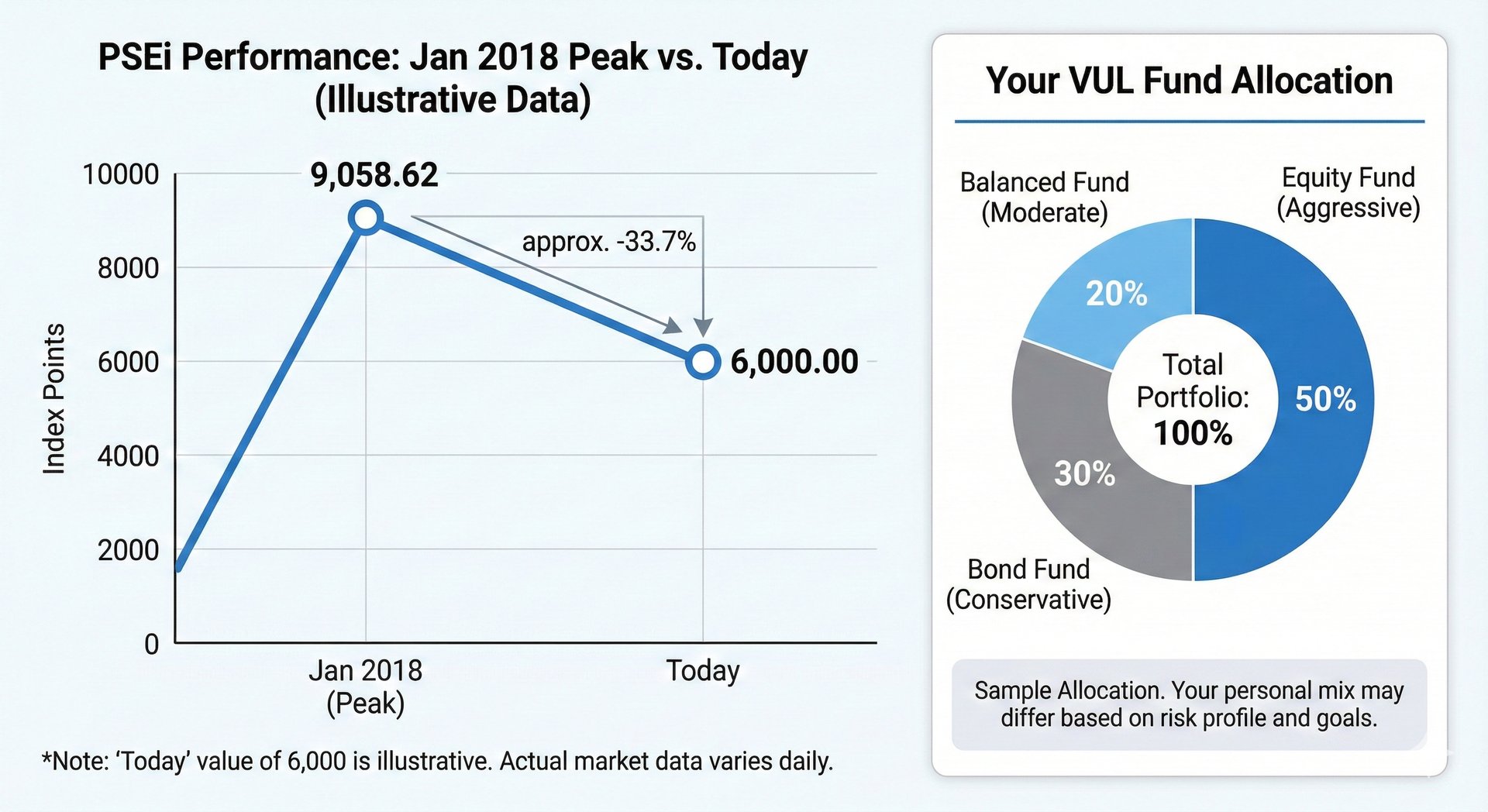
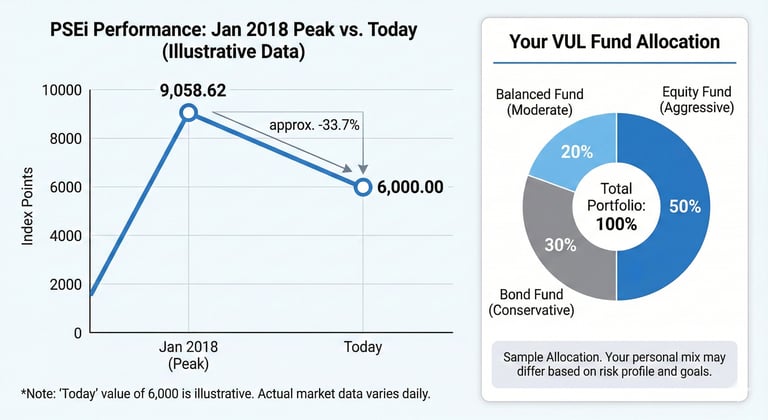
Many VULs are heavy in Philippine equities. The PSEi reached an all-time high monthly high of 9,078.37 in January 2018.
For context, the PSEi closed at 6,022.24 on November 28, 2025.
As of December 22, 2025 (market open update), the PSE Edge index summary showed the PSEi around 5,982.91.
If your VUL was concentrated locally, that alone can explain why “a decade later” still feels underwhelming.
Sources [1]: PSE Composite Index - Wikipedia [2]: PSEi, peso start 2018 with a bang - Philippine News Agency [3]: PSEi Composite Index Today (PSI) - Investing.com
3. Charges continue even when returns are weak
A VUL has insurance and policy charges, plus fund management fees. When markets are flat or down, charges become more noticeable because they still get deducted.
Investor education guidance on variable life is direct: fees and expenses reduce account value and can require additional premiums to prevent the policy from terminating.
4. Cost of insurance rises as you age
Even if your premium stays the same, the insurance cost inside the policy typically increases with age. If the policy is underfunded or markets are weak, a larger portion of your cash value can be used to pay charges.
5. Fund choice and concentration risk
Many VULs end up concentrated in one country, one theme, or one risk level. A single-market decade can disappoint, even if other markets did well. The practical fix is diversification inside the policy, not reacting to headlines.
6. Timing and premium pattern
If you paid more near market highs, paused premiums early, or treated the plan as “set and forget,” compounding may not have had the runway you assumed.
7. You might be looking at the wrong number
Clients who rarely check often compare total premiums paid versus fund value. A VUL premium is not 100 percent investment. Part of what you paid bought insurance coverage and paid policy costs. So the right question is sustainability and fit, not only performance.
What is not bad news right now
1. The Philippines is not in an “economic collapse” setup
The IMF country page for the Philippines shows projected real GDP growth and inflation figures that support a stable macro picture, not a crisis narrative.
2. Inflation has cooled from the spike period
The BSP’s Monetary Policy Report (August 2025) described a moderate inflation outlook, with inflation projected to remain below target until later in 2025.
This matters because a calmer inflation environment is generally more supportive for bonds, and it reduces pressure on household budgets.
3. Globally, growth is slowing but still positive
The IMF’s October 2025 World Economic Outlook projects global growth of around 3.2 percent in 2025 and 3.1 percent in 2026.
This is not a promise of market returns. It is simply a reminder that the global economy continues to function, which is what diversified portfolios need.


A simple 30-minute VUL health check
If you have not reviewed your VUL in 12 months or more, this is the checklist that matters, in this order.
1. Policy status and sustainability
A) Is the policy in force today?
B) Until what age is it projected to stay in force under realistic assumptions?
2. Charges and cost of insurance
A) What is the current cost of insurance and policy charges per year?
B) Is the charge trend rising faster than your cash value can support?
3. Fund allocation and diversification
A) Is your fund allocation aligned with your risk tolerance and time horizon?
B) Are you over-concentrated in Philippine equities or any single theme?
C) Do you need a portion in balanced or bond funds to reduce volatility, given your goals?
4. Riders and benefits
Are there riders or benefits you are paying for that you no longer need?
5. Funding adjustments, if there is lapse risk
If charges are rising and cash value is thin, you typically have four practical options.
A) Increase regular premium
B) Add top-ups, if allowed by your plan and appropriate for your cash flow
C) Adjust coverage structure if suitable and if insurability allows
D) Remove unnecessary riders that do not match your current needs
Maximum Oversight. Minimum Noise.
A low-touch management protocol designed for the private investor.
1. The Executive One-Pager. Instead of drowning in statements, you receive a single-page intelligence report: fund values, cost trends, and sustainability projections. No fluff, just the exact data you need to make a decision.
2. Strategic Allocation Reset We rebalance your portfolio based on your current time horizon, not yesterday’s news. This ensures your asset mix remains mathematically aligned with your goals, insulating your wealth from emotional market swings.
3. The Early Warning System We monitor "lapse risk" using strict thresholds. You are alerted to potential issues months in advance—when they are easy to fix—so your coverage never becomes an urgent crisis.
4. Estate & Legacy Calibration As your Chartered Trust & Estate Planner: I ensure your VUL remains an effective tool for estate liquidity and inheritance equalization. We annually audit ownership structures and beneficiary designations to prevent legal friction later.
"We can implement this entire framework in a single 20-minute strategy session. Once set, I handle the monitoring so you don’t have to."
© 2026 David Angway